


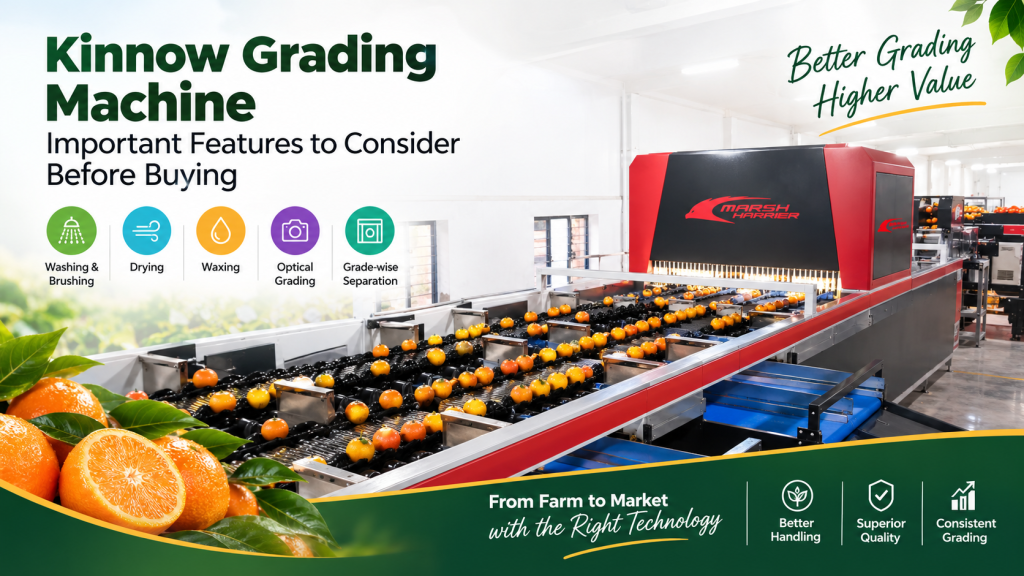
India is one of the major producers of Kinnow. After harvesting, proper post-harvest processing is essential to maintain fruit quality and prepare it according to market requirements. For commercial packhouses, traders and fruit processors, choosing the right Kinnow Grading Machine is an important investment.
A good Kinnow Grading Machine should offer more than high processing capacity. Features related to fruit handling, cleaning, drying, waxing and optical grading all contribute to the quality of the final product. The right combination of features can help improve grading consistency, minimise fruit damage and support efficient packhouse operations.
Before investing in a Kinnow Grading Machine, here are 10 important features to evaluate to find a solution that suits your processing requirements.
1. Damage-Free Automatic Crate Dumping Mechanism
The Crate Dumping System is an important feature to evaluate when selecting a Kinnow Grading Machine. Since fruit handling begins with unloading Kinnow from crates, the dumping mechanism should transfer fruit smoothly onto the processing line without unnecessary impact.
A suitable system should accommodate the required crate dimensions and provide controlled tilting. For example, a 90-degree dumping arrangement can help unload crates efficiently when it matches the machine design and packhouse requirements.
The key factors to consider are the smoothness of fruit movement, the stability of the dumping mechanism and the risk of bruising during unloading. Gentle handling helps maintain fruit quality, particularly in commercial packhouses processing large quantities of Kinnow.
2. Efficient Small-Fruit Removal System
Size uniformity is an important consideration when preparing Kinnow for different markets. A Small Size Fruit Removal system should separate undersized fruits according to the required grading specifications.
For example, a system configured to remove fruits smaller than 40 mm can separate smaller Kinnow before they move further along the processing line. The arrangement can also help remove loose leaves and other unwanted material, depending on the system design.
When evaluating this feature, consider the size separation accuracy, the fruit size range supported and the system’s ability to maintain a consistent flow of fruit. Early removal of undersized fruits helps improve the uniformity of the remaining lot and supports better preparation for market requirements.
3. 360° All-Round Fruit Rotation
Sorting Rollers are important for smooth fruit movement and effective surface inspection. One key feature to look for is the ability of the rollers to rotate Kinnow through 360 degrees while the fruit moves along the processing line.
This rotation exposes different sides of each fruit, making it easier to inspect the surface and identify visible damage. A well-designed roller arrangement can help operators or an integrated inspection system detect damaged fruits before they proceed to the next processing stages.
The roller material and rotation mechanism also matter. Hard-anodised aluminium rollers with a durable, scratch-resistant surface can be suitable for continuous fruit handling.
When choosing a Kinnow Grading Machine, evaluate the consistency of fruit rotation, the durability of the roller surface and the smoothness of fruit movement. These factors help support effective inspection while reducing the risk of unnecessary surface damage.
4. Thorough Washing and Brushing
An effective Washing and Brushing System helps remove dust, dirt and other surface impurities from Kinnow. The quality of cleaning depends on the brush arrangement, water distribution and suitability of the system for the fruit being processed.
Multiple rows of nylon brushes can help clean the fruit surface, while water sprinklers support consistent washing. Depending on the machine configuration, a foam-generation facility may also be available.
The brushes should provide effective cleaning without excessive abrasion. It is also important to consider how easily the system can be cleaned and maintained during regular operation.
A suitable washing and brushing arrangement improves surface cleanliness and prepares Kinnow for subsequent drying and waxing. The cleaning system should match the required processing capacity while maintaining consistent results across the fruit lot.
5. Rapid and Uniform Hot-Air Drying
The Drying System is an important feature to evaluate when washing and waxing are part of the Kinnow processing line. Excess moisture remaining on the fruit surface can affect the consistency of the waxing process.
A suitable system should provide uniform warm-air circulation and sufficient drying capacity for the required processing speed. Insulated panels, circulation fans and an appropriately sized blower can help distribute warm air throughout the drying section.
The heating arrangement and airflow should be designed according to the quantity of fruit being processed and the moisture that needs to be removed.
When evaluating a Kinnow Grading Machine, consider the uniformity of drying, energy consumption, insulation quality and compatibility with the machine’s throughput. Effective drying prepares Kinnow for more consistent waxing and helps maintain a smooth processing flow.
6. Precise and Uniform Wax Application
The Waxing System plays an important role in improving the finish of Kinnow after washing and drying. Fruit coating can help reduce moisture loss and maintain appearance during storage and transportation when the appropriate coating is used.
A suitable Kinnow Waxing Machine may include a dosing pump, rotary disc spreader and application brushes. The dosing mechanism controls the quantity of wax supplied, while the application arrangement helps distribute the coating evenly over the fruit surface.
Wax consumption is another important factor to consider. A well-designed system should minimise unnecessary wastage while providing consistent coverage. Adjustable dosing and spreader speed can help match the application to the coating requirements and processing conditions.
Before choosing a Kinnow waxing machine, evaluate coating uniformity, wax consumption, ease of adjustment and compatibility with the intended fruit coating. These features can influence operating costs and the final appearance of the produce.
7. Insulated Wax-Drying Tunnel
The Wax Drying Tunnel helps dry the applied coating under controlled conditions. Its insulation, heating arrangement and air circulation directly influence drying performance and energy use.
An insulated tunnel with PUF panels can help reduce heat loss, while circulation fans distribute warm air throughout the tunnel. The heating system should maintain suitable conditions for the coating being used and the speed of the processing line.
LPG-based indirect heating is one option for commercial packhouses. In this arrangement, heat is transferred through a heat exchanger, preventing combustion gases from mixing directly with the process air.
When evaluating this feature, consider tunnel length, insulation quality, heating capacity and the uniformity of air circulation. These factors can influence coating drying, energy consumption and the overall efficiency of the Kinnow processing line.
8. Accurate Fruit Singulation and Transfer
The Transfer Belt and Fruit Singulator are important for maintaining smooth fruit movement and preparing individual Kinnow for optical grading.
The transfer belt should move fruit between machine sections without unnecessary drops, accumulation or sudden changes in direction. Its design should suit the packhouse layout and the required processing capacity. Where the machine layout requires a right-angle turn, the transfer arrangement should accommodate that movement smoothly.
The Fruit Singulator has a different but equally important role. It separates and positions fruits individually before they enter the optical grading section. Proper separation helps prevent fruits from overlapping and allows the imaging system to inspect individual Kinnow more effectively.
When evaluating this combined feature, consider belt design, fruit transfer quality, singulation accuracy and compatibility with the optical grader’s speed. Smooth transfer and consistent fruit spacing help support reliable grading performance.
9. Super Intelligent AI-Powered Optical Grading
Optical Grading Technology is one of the most important features of a modern Kinnow Grading Sorting Machine. Unlike conventional systems that primarily depend on mechanical size separation, an optical grader uses cameras, imaging technology and electronic analysis to evaluate selected fruit characteristics.
Before investing in an optical grader, consider the following capabilities:
Size Grading: The system should separate Kinnow into configured size categories according to the requirements of different markets.
Colour Grading: Colour assessment helps separate fruits according to their colour characteristics and supports more consistent lot formation.
External Defect Detection: The grading system should be capable of identifying visible surface defects. Its performance should be evaluated using actual Kinnow varieties and different surface conditions.
360-Degree Fruit Inspection: A suitable imaging and fruit rotation arrangement helps capture different sides of the fruit, providing a more comprehensive surface assessment.
Processing Speed and Capacity: The machine should match the required throughput while maintaining grading accuracy. Its rated capacity should be evaluated alongside the number of lanes and performance under actual operating conditions.
Grading Consistency: The system should produce consistent results according to the selected grading parameters. The accuracy of colour, size and defect classification is important when preparing commercial fruit lots.
An optical grader with suitable imaging capabilities can help reduce dependence on manual visual sorting and improve consistency in fruit grading.
10. Multiple Exits with Accurate Crate Filling
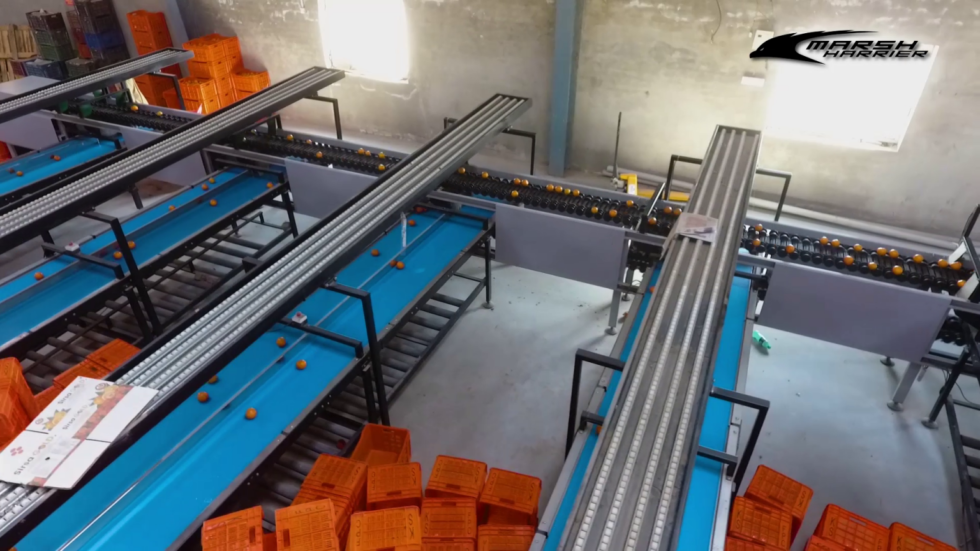
Multiple Exit Points and Crate Filling Stations are important for managing the output of a Kinnow Grading Machine. After grading, fruits belonging to different categories need to be directed towards their respective collection points.
Multiple exit points allow different grades to be separated according to the machine’s configured grading criteria. This helps packhouse operators organise fruit lots according to size, colour or other supported quality parameters.
Crate Filling Stations should be positioned conveniently for operators and designed to support smooth fruit collection. Their arrangement should minimise unnecessary fruit drops and allow crates to be replaced without interrupting the entire processing line.
When evaluating this feature, consider the number of grading exits, the flexibility of grade allocation, crate-filling convenience and the space available in the packhouse. A suitable arrangement can make graded fruit easier to collect, organise and prepare for dispatch.
Real-World Experience: Baba Fruits’ Review of Marsh Harrier
Understanding the important features of a Kinnow Grading Machine helps you evaluate the right solution for your packhouse. Along with these features, the experience of packhouse owners who use the machine in their daily operations can offer valuable practical insights.
Watch the review of Baba Fruits to learn about their experience with the Marsh Harrier Kinnow Grading Machine and its performance in actual packhouse operations.
Conclusion
Choosing the right Kinnow Grading Machine involves evaluating the features that influence fruit handling, cleaning, drying, waxing, grading accuracy and collection of the final output. Each feature has a specific role in supporting efficient packhouse operations and preparing Kinnow according to market requirements.
Before making a purchase, compare machine capabilities, processing capacity, grading parameters, operating costs and after-sales support. A machine that matches your fruit quality requirements and daily processing needs can help improve consistency and make post-harvest operations more efficient.
Marsh Harrier offers Kinnow Grading & Sorting Solutions designed for commercial fruit-processing requirements, combining fruit-handling systems with washing, drying, waxing and AI-powered Optical Grading Technology. Selecting the right configuration depends on the needs and scale of your packhouse.