






1. Before the Apple Revolution
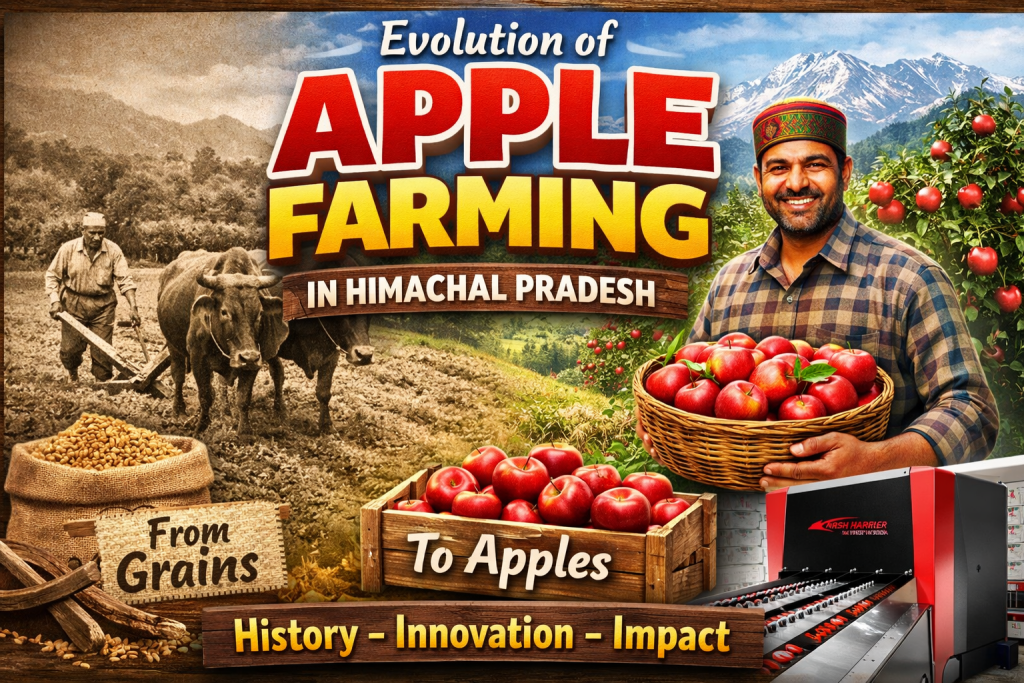
Today, when we take the name of Himachal Pradesh, the first thing that comes to our mind is apples. But do you know what was grown in Himachal before apple cultivation?
Until around 1900, farming in Himachal was not done for the market, but for household needs. According to British Gazetteers, during that time around 80 to 85 percent of agriculture was dependent only on food grains.
During winters, wheat and barley were grown in the fields, while in summers maize was cultivated on the slopes of the mountains. In the lower valleys of Kangra and Chamba, rice cultivation was practiced. The real strength of the hills was coarse grains like kodra, kangani, ogla and amaranth, which were capable of surviving drought, cold, and food scarcity. Every household had pulses like rajmah and kulthi, and mustard was grown for oil.
Before 1900, farming was considered incomplete without sheep, goats, cows, and oxen. Even before apples, in the 1820s, British Major Kennedy introduced the concept of potatoes in Himachal, which became the region’s first cash crop.

2. From Grains to Apples: Why Did Farmers Change Their Path? | Apple Farming in Himachal Pradesh
Grain farming required a lot of effort, but the full potential of soil and climate was not being utilized. Grains could fill the stomach, but the cash income was not enough to support family growth or provide security during difficult times.
Apple farming in Himachal Pradesh taught farmers how to use their land more efficiently by working in harmony with nature, and it provided them with the financial support needed to give their families a secure and dignified future. This was not driven by greed for money, but by the understanding of the true potential of their land. The apple revolution also reconnected the youth with their roots.
Then in 1916, Satyanand Stokes arrived in Kotgarh. He distributed apple saplings for free and taught farmers the correct methods of apple cultivation. When the apple crop in Kotgarh turned out to be successful, nearby farmers saw the results themselves and gradually started adopting apple farming.
Today, apples are the identity of Himachal and the livelihood of lakhs of farmers. This journey from grains to apples is not just a story of changing crops, but a decision that transformed farmers’ lives.

3. How Did Himachal Pradesh Become the Apple State of India?
Today Himachal is known as the Apple State of India, but it took years of effort by farmers to reach this stage.
This journey began in 1870, when Captain R.C. Lee of the British Army planted India’s first apple orchard in Bandrol Valley of Kullu and introduced English varieties like Newton Pippin and King of Pippin. However, these apples were sour and did not suit the Indian market, so apple cultivation did not expand at that time.
The real transformation started in 1916 from Kotgarh, when Satyanand Stokes introduced the Red Delicious variety from America. This variety was sweet, visually appealing with its bright red color, and highly suitable for the climatic conditions of the Himalayan region.
In 1926, its first crop reached the market and quickly gained popularity. Seeing its success, farmers in nearby regions started adopting apple cultivation, and it gradually spread to Shimla, Kullu, and Mandi.
Recent Innovations
The “Apple Man of India”, Hariman Sharma, developed the HRMN-99 variety, which can grow in warmer climates up to 40°C, making apple cultivation possible beyond traditional cold regions.
Today, apples are not just a crop but a major part of Himachal’s economy and a key driver of the apple industry in India.

4. Weather and Evolution of Agri Inputs in Apple Farming
Farming in Himachal has never been easy, and apple cultivation has always been tested by weather conditions every year.
Over time, the weather changed, winters became less cold and their timing started to shift. These changes did not stop farmers but forced them to change their thinking and methods. Gradually, apple cultivation started shifting towards higher altitude areas.
Along with this, farming tools and agricultural inputs also evolved.
From 1920 to 1960, farming in the hills was mostly done using wooden ploughs, oxen, and manual labor. Manure from livestock was used as fertilizer. Then in the 1970s and 1980s, fertilizers like urea and NPK were introduced, along with tools like spray pumps, which increased productivity.
During this period, heavy wooden boxes were replaced by lighter Corrugated Fiber Board (CFB) boxes, making apple transportation easier and safer. After 2000, apple farming took a new form. Instead of seed-grown trees, dwarf rootstocks imported from Italy and America began to be used, which started bearing fruit in just three years.
Today, weather information is available through mobile phones, and decisions like when and which spray to use are now based on data and modern farming practices. Today, Himachal is gradually moving from traditional farming toward smart farming by adopting new technologies in agriculture.

5. Apple Grading Before Machines (Manual Grading)
There was a time in Himachal’s apple story when apples were graded not by machines, but by human eyes.
In the 1960s-70s, orchards looked very different. Apples were spread on the ground or in kiltas and sorted by hand. There were no machines, and grading was done entirely manually. The size of apples was judged only by visual estimation.
For some, a large apple meant A grade, while for others the same apple could be considered B grade. In other words, the same apple could have different grading decisions. At that time, most packing was done in wooden boxes. These boxes were heavy and did not provide enough protection inside.
Repeated handling caused bruises on apples, and often good apples were packed together with some bad apples in the same box. By the time these boxes reached distant markets, some apples would get damaged during transport.
When traders opened the boxes in mandis, they would show one or two damaged apples and reduce the price of the entire box. In this way, even after full hard work, farmers did not get the correct price for their produce due to lack of proper apple grading.

6. Mechanical Grading in Apple Industry
With time, the method of apple grading began to change.
Around the 1990s, mechanical grading machines started being used in Himachal, and gradually their usage increased. Instead of spreading apples on the ground and sorting by hand, apples were now passed through machines. With the help of belts, apples moved forward, and through rollers, they were graded based on size.
In this process, small, medium, and large apples were separated. During the same period, packing methods also changed. Wooden boxes were replaced with cardboard boxes, reducing damage during transportation.
Gradually, packhouses were developed where grading and packing were done in a systematic way. Now apples were not just harvested and sold, but prepared according to market demand.
However, even after mechanical grading, some problems remained, as this system was based only on size and weight.
7. AI Apple Grading Machine | Future of Apple Grading Technology
If we talk about apple grading, in the past few years this technology has completely transformed.
This is where optical grading technology begins, and AI-powered grading machines are now being introduced at the grower level in Himachal Pradesh by Marsh Harrier. Now apples are not graded only on the basis of size or weight, but are scanned and analyzed using high-resolution cameras.
When an apple passes through the machine, a 360-degree rotating camera system captures multiple images from all angles. The system identifies color variation, shape, size, and surface defects. Based on predefined quality parameters, apples are then sorted into different grades and packed in boxes.
Today, grading has become much more accurate and consistent compared to before. It is no longer based on estimation, but completely on data and technology. The biggest benefit of this goes to farmers, as proper grading makes packing more uniform and market-ready.
The problem of mixed quality packing is eliminated, transport damage is reduced, and due to maintained quality, better prices are achieved in the market.
This is why today the apple industry is rapidly moving towards AI-based apple grading machines and optical sorting technology.


