



Introduction: Why Post-Harvest Handling Defines Apple Value
In modern apple farming, the true value of produce is not determined only in the orchard, but also by what happens after harvesting. Today’s markets demand uniformity, consistency, and premium presentation. Buyers are no longer just purchasing apples – they are purchasing graded quality and reliability.
This is why apple grading, sorting, and packing processes have become critical for growers, traders, and packhouse operators. A structured post-harvest system not only improves price realization but also builds long-term trust in competitive markets.
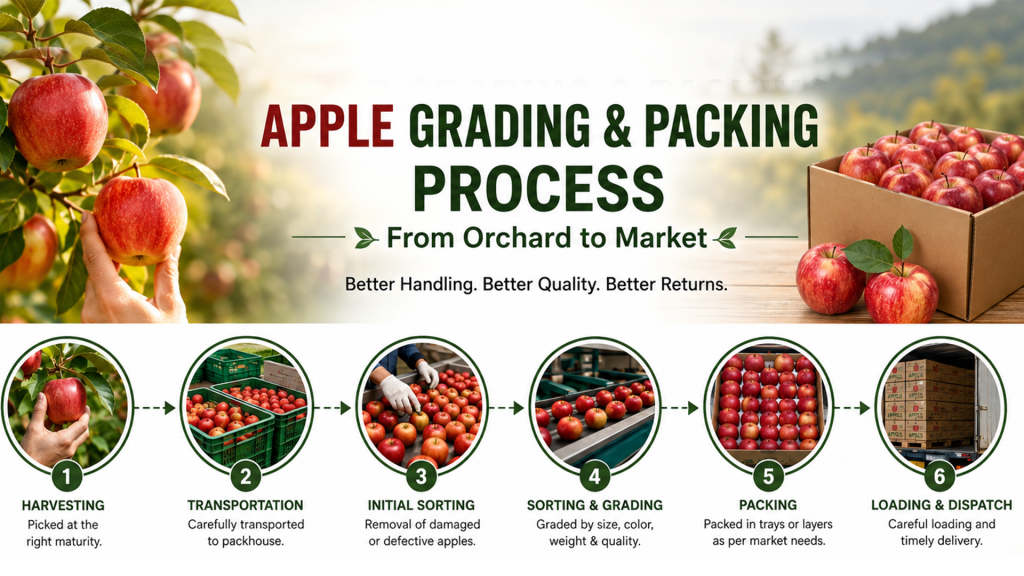
Step 1: Apple Harvesting – Where Quality Begins
The journey of high-quality apples starts in the orchard. Harvesting must be done at the correct stage of maturity to ensure optimal color, firmness, and shelf life.
Careful hand-picking is essential to avoid bruising and damage. Even minor handling errors at this stage can significantly impact final grading results and reduce the overall market value.
Step 2: Transportation to Packhouse
After harvesting, apples are transported to the packhouse using crates or boxes. Proper transportation is crucial to maintain fruit integrity.
Overloading, improper stacking, and rough handling during transit can cause internal damage, which may not be immediately visible but can negatively affect grading and pricing later.
Step 3: Arrival & Initial Sorting
At the packhouse, apples undergo an initial inspection. Damaged, rotten, or defective fruits are removed during this stage.
This ensures that only high-quality apples move forward into the grading process, maintaining consistency and reducing waste in later stages.
Step 4: Sorting & Grading – The Core of Value Creation
Sorting and grading is the most critical stage in the apple post-harvest process, as it directly determines the market value, pricing, and buyer acceptance of the produce.
At this stage, apples are evaluated on multiple quality parameters, including color, size (in millimeters), weight, and external defects such as spots, bruises, or surface blemishes. The combination of these factors defines the final grade assigned to each apple.
Size Classification
Apples are classified into standard commercial sizes such as XL, L, M, S, and XS, along with 6 Layer and Pittoo categories. Each size affects packing style, presentation, and market pricing, where larger sizes are generally preferred for premium markets.
Color Grading
Color is one of the most important visual parameters in apple grading and significantly influences buyer preference and market demand. Apples are generally classified based on color development into:
- Full Red (80-100% color coverage)
- Medium Red (60-80% color coverage)
- Low Color (below 60% color coverage)
These color categories may vary slightly depending on regional market requirements and buyer specifications. However, maintaining uniform color consistency within each grade is essential to achieve better pricing and premium market acceptance.
Role of Modern Grading Systems
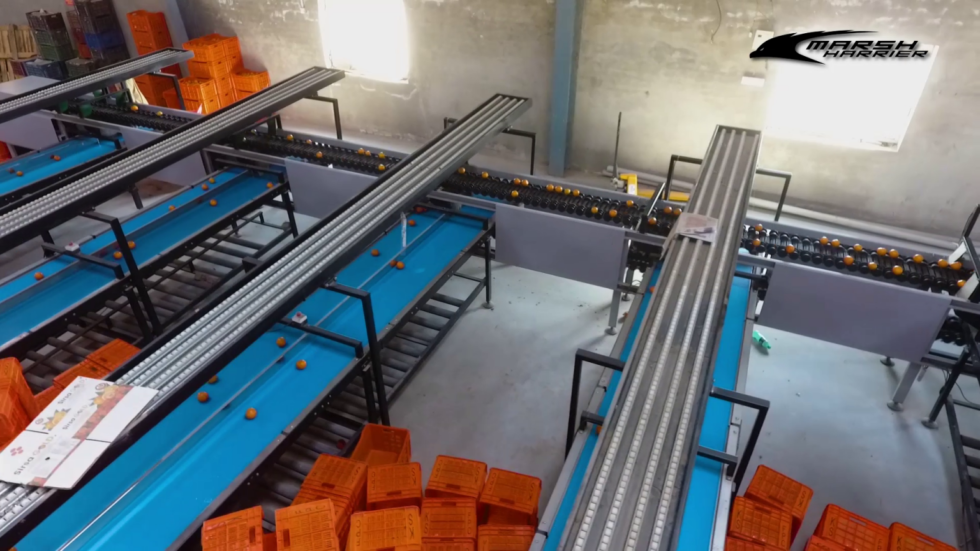
With the increasing demand for accuracy and consistency, modern grading systems such as Marsh Harrier AI-powered apple grading machines enable packhouses to process apples based on multiple parameters simultaneously.
These systems evaluate size, color, weight, and defects in one integrated process, significantly reducing manual errors and ensuring uniform grading output. This level of precision is essential for large-scale operations, where consistency and speed directly impact market value and profitability.
Step 5: Standard Apple Packing Formats (Industry Practice)
After grading, apples are packed using standardized formats to maintain consistency in weight, count, and presentation, typically in 20-22 kg cartons.
Tray-Based Packing System
The most widely used method, tray packing, ensures protection and premium presentation.
In a standard 5-tray system:
- XL size apples are packed as 80 apples per carton
- L size apples are packed as 100 apples per carton
- M size apples are packed as 125 apples per carton
- S size apples are packed as 150 apples per carton
- XS size apples are packed as 175 apples per carton
Each tray is designed according to the size of apples, ensuring proper spacing, protection, and premium presentation.
6-Layer Packing System
In this method, apples are packed in six structured layers with separators placed between each layer. It provides a balance between cost efficiency and protection, making it suitable for mid-range markets.
Pittoo Packing (Loose Packing)
Pittoo packing is a traditional and economical method where apples are packed without trays.
- Apples are tightly filled into cartons (7+ layers)
- Suitable for bulk and price-sensitive markets
- Requires careful handling to avoid pressure damage
Step 6: Packing Process – Designed for Market Needs
After grading, apples are packed according to their size, quality, and target market requirements.
Cartons are generally prepared in different weight categories such as 5 kg, 10 kg, and 20-22 kg boxes. The choice depends on buyer demand, logistics, and market positioning.
Tray packing is preferred for premium grades due to its superior presentation and protection, while pittoo or layered packing is used where cost efficiency is more important.
Step 7: Types of Carton Boxes Used
Packaging quality plays a crucial role in ensuring safe delivery.
Types of cartons include:
- Liner Boxes – High strength, ideal for premium apples and long-distance transport
- Duplex Boxes – Balanced option between durability and cost
- Virgin Boxes – Economical, suitable for short distances and lower grades
Selecting the right carton depends on the packing method, weight, and transportation distance.
Step 8: Loading and Dispatch
Proper loading and transportation are essential to maintain quality.
Key factors include:
- Correct stacking
- Adequate ventilation
- Careful handling
Even at this final stage, poor handling can result in significant losses.
Why Standardization Matters in Apple Marketing
Without proper grading and packing, the apple market becomes inconsistent and unreliable.
A standardized system ensures:
- Uniform quality in every box
- Better price realization
- Stronger buyer relationships
- Higher acceptance in premium markets
Standardization is no longer optional – it is essential for growth and scalability.
Conclusion: Quality is Built Through Process
The journey of apples from orchard to market involves multiple carefully managed steps. Each stage – harvesting, transportation, grading, and packing – contributes to the final value of the produce.
By following a systematic approach, growers and packhouse operators can significantly improve both quality and profitability.
In today competitive market, success comes not just from producing apples, but from presenting them in the most consistent and market-ready form.
If you want to understand how modern grading systems can help improve consistency and market returns, connecting with the right guidance can make decision-making much easier.